
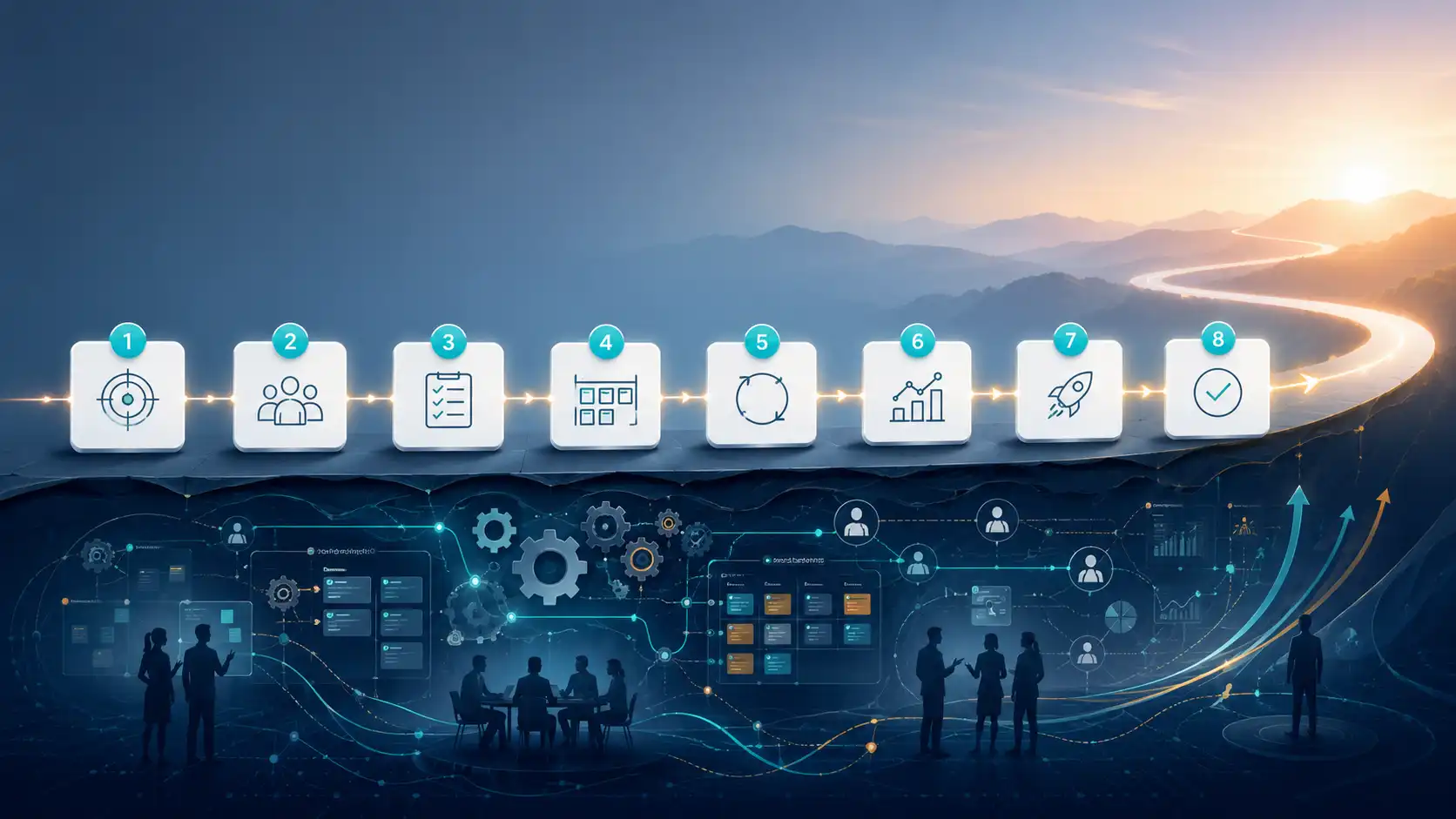
In this article, The Digital Project Manager describes eight practical steps which in themselves are sound. They provide a useful high-level framework for creating an agile workflow. But even the article acknowledges that implementation requires careful planning, execution, appropriate software, training and ongoing support. The problem is not knowing what the eight steps are.
The problem is translating them into a practical operating model that works within the realities of your organisation – and then making that new way of working stick.
The Framework Is Simple. The Organisation Is Not.
An agile workflow is not simply a task board with columns labelled “To Do”, “In Progress” and “Done”.
Nor is it a collection of ceremonies involving stand-ups, sprint planning sessions and retrospectives.
A genuine agile transformation changes how decisions are made, how work enters the organisation, how teams collaborate, how leaders exercise control and how success is measured.
That creates complexity beneath every apparently simple step.
1. Defining Goals and Securing Buy-In
Agreeing that the organisation should become “more agile” is relatively easy.
Agreeing what that means is harder.
Senior leaders may want greater predictability. Product teams may want more autonomy. Finance may want firmer commitments. Customers may expect fixed deadlines. Delivery teams may want protection from continually changing priorities.
These objectives can conflict.
Before designing a workflow, organisations need to establish:
- The business outcomes the change is intended to deliver
- Which problems the new approach must solve
- How success will be measured
- Who owns the transformation
- Which decisions teams can make independently
- Where governance and approval remain necessary
Without that alignment, the organisation may adopt agile terminology while continuing to operate through its existing command-and-control structures.
2. Prioritising the Backlog
A prioritised backlog sounds simple until every stakeholder believes their requirement should be at the top.
Effective prioritisation requires more than rearranging tickets. It needs a transparent mechanism for comparing customer value, revenue impact, operational risk, regulatory obligations, technical debt, dependencies and delivery effort.
It also needs clear decision rights.
Who has the authority to change priorities? What happens when an executive introduces urgent work during a sprint? How are unplanned support issues handled? Who decides whether a technical improvement is more valuable than a new customer-facing feature?
Without an agreed prioritisation model, the backlog becomes a repository of competing demands rather than a meaningful delivery plan.
3. Establishing a Sprint Cadence
Choosing a one-, two- or four-week sprint is the easy part.
The harder work involves designing a delivery rhythm that reflects:
- The type and size of work being delivered
- Team capacity and availability
- External dependencies
- Testing and assurance requirements
- Customer review cycles
- Release windows
- Support responsibilities
- The organisation’s appetite for change
Teams must also learn how to estimate effectively, break work into deliverable increments, manage work in progress and avoid consistently overcommitting.
A sprint cadence should create focus and predictability. Poorly implemented, it simply creates a recurring deadline every two weeks.
4. Creating Cross-Functional Teams
A cross-functional team is not created by inviting people from different departments to the same meeting.
The team needs the capabilities and authority to take work from concept through to completion without repeatedly handing it between organisational silos.
That may require changes to reporting lines, responsibilities, allocation models and management behaviours.
Roles such as Product Owner and Scrum Master also need to be properly defined. Simply assigning the titles to existing employees does not guarantee that they have the time, experience or organisational authority to perform them.
Teams cannot be held accountable for outcomes while remaining dependent on decisions made elsewhere.
5. Holding Regular Meetings
Agile ceremonies are intended to improve collaboration, expose risks and accelerate decisions.
Without effective facilitation and coaching, they can quickly become additional layers of administration.
Daily stand-ups become status reports to a manager. Sprint planning becomes a negotiation over impossible workloads. Reviews become demonstrations with no meaningful stakeholder feedback. Retrospectives identify the same problems every fortnight without anyone addressing them.
The meeting format is not the capability.
Teams need to understand the purpose of each ceremony, how to prepare for it, how decisions will be recorded and how actions will be followed through.
6. Building a Release Process
Delivering work at the end of a sprint does not automatically mean it is ready to release.
A sustainable release process may need to incorporate:
- Quality assurance
- Security testing
- Data protection
- Accessibility
- Regulatory compliance
- Business acceptance
- Deployment automation
- Change approval
- Communications
- Training
- Operational support
- Rollback and recovery planning
These controls must be integrated into the workflow rather than added as a final gate after development has finished.
Otherwise, teams may appear to be delivering quickly while completed work accumulates in a queue waiting for approval, testing or deployment.
7. Implementing Agile Tools
Tools such as Jira, Azure DevOps, Monday.com and other workflow platforms can provide valuable visibility, automation and reporting.
They can also automate a badly designed process.
Before configuring the platform, organisations need to define their workflow, terminology, governance model, roles, reporting requirements and integration points.
The implementation may then involve:
- Designing project and board structures
- Configuring workflows and status transitions
- Creating issue types and data fields
- Establishing permissions
- Building dashboards and management reporting
- Integrating development, testing and support tools
- Migrating existing work
- Automating repetitive activities
- Training users
- Establishing platform ownership and support
Buying the software is rarely the difficult part. Configuring it to reinforce the right behaviours is where the value is created.
8. Creating Continuous Improvement
Continuous improvement is often the first principle organisations endorse and the first one abandoned when delivery pressure increases.
Retrospectives only create value when teams feel able to discuss problems honestly and leaders are prepared to act on what they hear.
Improvement also needs evidence. Teams should be able to evaluate measures such as delivery lead time, throughput, work in progress, predictability, quality, customer outcomes and avoidable rework.
The objective is not to maximise the number of tasks completed. It is to improve the flow of valuable outcomes through the organisation.
That requires sustained leadership attention – not just an occasional workshop.
Why Agile Implementations Fail
Most unsuccessful agile transformations do not fail because the organisation forgot to schedule a daily stand-up.
They fail because the underlying operating model did not change.
Common failure patterns include:
- Implementing a tool before designing the process
- Renaming project managers as Scrum Masters without changing their responsibilities
- Expecting Product Owners to perform the role alongside a full-time day job
- Retaining governance designed for large, sequential projects
- Measuring individual utilisation rather than team outcomes
- Introducing ceremonies without explaining their purpose
- Rolling out a standard process that ignores organisational context
- Providing initial training without ongoing coaching
- Treating adoption as an IT initiative rather than organisational change
The result is often “agile theatre”: the organisation uses agile terminology and attends agile meetings but experiences little improvement in speed, quality or customer value.
Making the Transition Stick
A successful transition needs coordinated change across three dimensions.
Process
The workflow must be designed around how value moves through the organisation. Roles, decision rights, governance, prioritisation, assurance and performance measures must work together.
Tools
The technology must make the process easier to follow, provide meaningful visibility and automate administration without becoming an industry in its own right.
People
Leaders, managers and delivery teams need practical coaching while they learn new responsibilities and behaviours. Training explains the framework. Coaching helps people apply it when real-world pressures emerge.
Neglect any one of these dimensions and the transformation is unlikely to deliver its intended outcomes.
Agile Is Easy to Describe and Difficult to Operationalise
The eight steps provide a valuable starting point.
But a list of steps is not an implementation plan.
Every organisation has different customers, systems, governance obligations, commercial pressures, team structures and cultural constraints. The right agile operating model must be designed around that context rather than copied from a textbook or replicated from another business.
At {n}.bora, we help organisations turn agile theory into a practical, sustainable way of working.
We work with you to design the processes, select and configure the tools, establish proportionate governance and coach your teams through the transition. The objective is not to make your organisation appear agile. It is to create a delivery capability that is genuinely more responsive, transparent and effective.
Ready to Move Beyond Agile Theatre?
Whether you are introducing agile for the first time, struggling with an implementation that has stalled or trying to scale successful practices across the organisation, we can help.
Talk to {n}.bora about building an agile delivery model that works in practice – and continues working after the consultants have left.